






AI MEP design
AI MEP design: fourteen systems, generated with the building
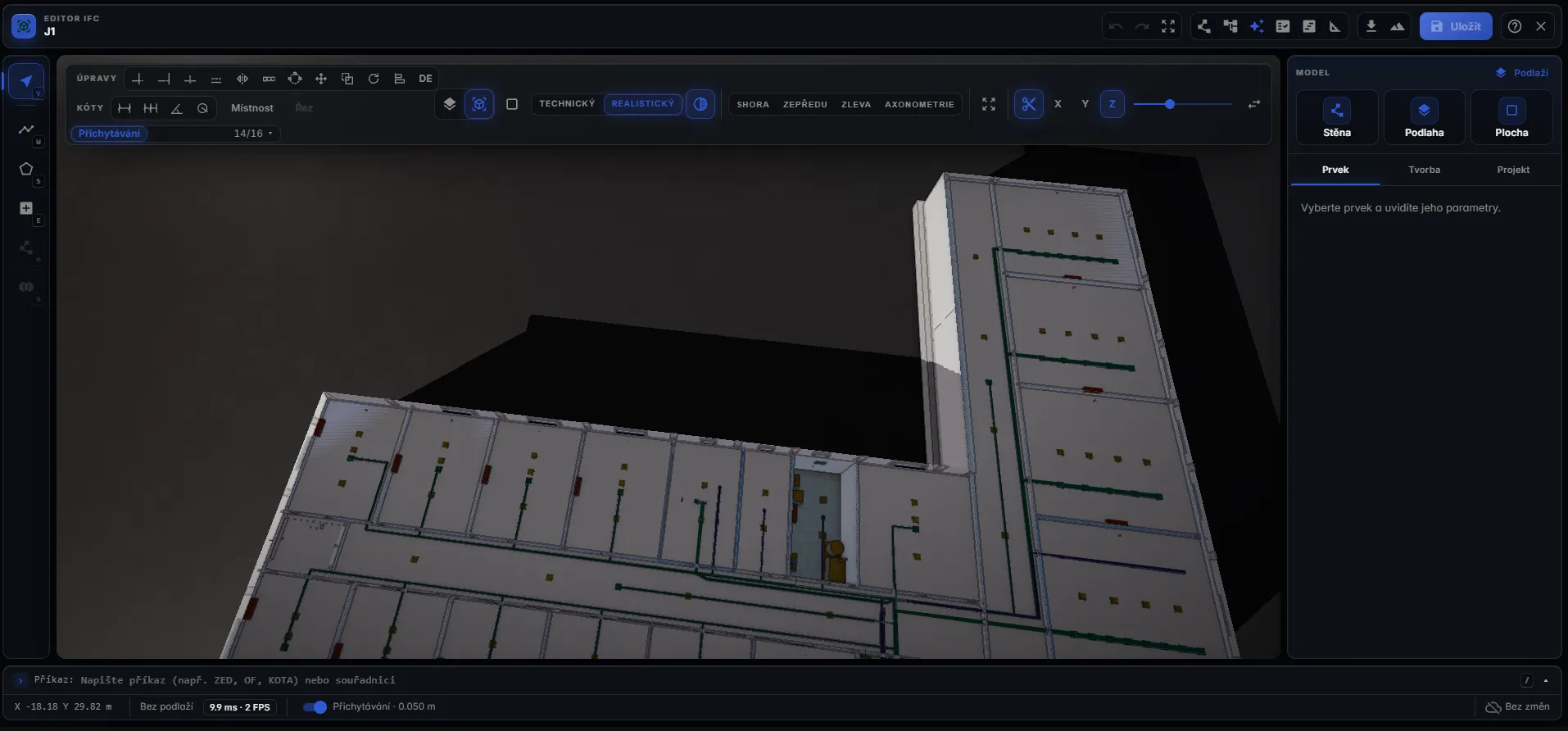
BIM Harness lays out ventilation, cooling, heating, water, drainage, power, low-voltage, fire and gas systems in the same run that builds the architecture and the structure. Clash checking runs inside generation and services are rerouted automatically, so coordination starts before the model reaches you - as a design starting point for an engineer to review, in open IFC.
- Fourteen MEP systems from one brief, from domestic water to medical gases
- 4,004 MEP components in a 23,321-element hospital
- Hard clashes measured analytically and rerouted during generation
- Penetrations cut into the structure, shafts and risers placed
What is generative MEP design?
Generative MEP design is the automatic layout of connected building services - equipment, mains, risers and terminals for several systems at once - inside the building model, from the design intent rather than by drawing each run. In BIM Harness it happens in the same run that generates the building, with clash checking built in.
Most tools sold as AI MEP design do one thing for one system inside existing desktop software: size a duct network, suggest a cable route, lay out sprinkler heads. That is useful, but the engineer still has to assemble the systems, find space for them and coordinate them against the structure and each other. The honest conclusion of most writing on the subject is that AI cannot yet replicate the MEP design flow.
BIM Harness approaches it from the other end. Because it generates the whole building, it knows where the rooms, the ceiling voids, the shafts and the columns are before the first duct is placed. The MEP roles in the AI team decide what each system needs; deterministic resolvers - not the language model - do the layout and the clash resolution. The same script against the same kernel gives the same services.
Services in the ceiling void of a hospital ward
The fourteen systems, grouped by trade
Each system is a connected network from source to terminal, not a set of loose segments.
HVAC with heat recovery
Air handling with heat recovery, supply and extract ductwork in the ceiling void, vertical distribution through shafts to the rooms that need air.
Chilled water and heating
Chilled water for cooling. Heating from boiler cascades through distribution pipework to radiators.
Domestic water and drainage
Domestic water with circulation. Drainage laid to falls, so gravity runs slope the way they have to.
Gas and medical gases
Gas distribution, and in healthcare buildings medical gases routed all the way to the beds.
Power distribution
Service connection, switchroom, boards per floor, feeders sized for the load and final circuits, carried on cable trays.
Emergency lighting, lightning protection, EV charging
Emergency lighting, lightning protection with earthing, and EV charging points.
Data and low-voltage
Structured data cabling and low-voltage systems, kept apart from power.
Fire alarm and sprinklers
Fire alarm and sprinkler systems laid out with the rest of the services.
Coordination during generation, not after
In BIM Harness clash checking is part of MEP generation: every route is measured analytically against the structure and the other services while it is laid, and automatic repair reroutes services until the model has no hard clashes.
The usual workflow finds clashes after the fact. Each trade models its services, the models are federated, a clash detection run produces hundreds of issues, and a coordination meeting triages them. Tools for that post-hoc triage are good at what they do. But every clash they report is design work that has to be redone.
Harness moves the check into generation. Clashes are measured analytically: the distance between two route axes minus their radii, or whether a centreline passes through a solid. When a route collides, the resolver reroutes it and checks again. The repair targets hard clashes - physical intersections between services, or between a service and the structure. The site’s reference hospital left generation without hard MEP clashes; that is one documented case, and the reason we describe the mechanism rather than promise a number for every model.
Clearances for maintenance, insulation build-ups and installation tolerances are part of the engineer’s review, as they would be on any model.
How the check works inside generation
- 1
Route
The resolver lays mains in the ceiling void and vertical runs through shafts and risers, following the rooms that the architecture generated as IFC spaces.
- 2
Measure
Each route is tested analytically against the structure and other services: axis-to-axis distance minus radii for runs, containment of a centreline in a solid for structure.
- 3
Reroute
A hard clash triggers automatic repair: the service is rerouted and measured again, until there are no hard clashes left in the model.
- 4
Cut
Where a service legitimately passes through a slab or a wall, the penetration is cut into the structure instead of being left as an intersection.
- 5
Report
Remaining problems are returned as named, machine-readable findings such as clash.hard, which feed a repair plan for the next round.
Post-hoc clash detection vs coordination in generation
| Clash detection after modelling | BIM Harness | |
|---|---|---|
| When clashes are found | After the trades have modelled their services | While the services are being laid |
| How they are measured | Geometry intersection in a federated model | Analytically: route axes, radii, containment in a solid |
| What happens to a hard clash | An issue assigned to someone to fix | Automatic rerouting, then measured again |
| Penetrations | Coordinated and modelled separately | Cut into the structure during generation |
| Where it fits | Existing models from several authors | New designs generated in Harness |
The two are not exclusive. A Harness model exports to IFC4X3 and can go into your existing coordination tools like any other model.
MEP in the reference hospital
14
MEP systems from one brief
4,004
MEP components in the model
23,321
elements in the whole building
~13 min
from the brief to the finished model
~6 s
to lay the MEP of a family house in the browser
21
reference buildings in the benchmark
Every release is guarded by 4,500+ automated tests and a benchmark of 21 reference buildings, from a bungalow to a hospital wing with medical gases. Live runs on real briefs keep testing the whole chain.
A design starting point, reviewed by an engineer
Generated MEP is a first coordinated layout, not a stamped design. BIM Harness sizes feeders for the load and lays out connected systems, but it does not claim code compliance for your jurisdiction and does not replace the calculations an MEP engineer signs off. What it removes is the blank model: the engineer starts from connected networks that already fit the building and change the parts that need changing.
Everything is editable. Ducts, pipes and cable trays are parametric elements in the browser editor; you can move a run, change a system or ask the AI with the next sentence. The same scripting API the AI uses - including verbs such as api.duct, api.pipe, api.cableTray, api.riserShaft, api.plantRoom and api.autoServices - is available to you for batch edits (Studio plan and higher).
The services leave Harness as IFC4X3 entities with typed properties, alongside the architecture and the structure they were coordinated with. Your consultants open them in the tools they already use.
Frequently asked questions
Can AI design MEP systems?
AI can produce a coordinated first layout, which is what BIM Harness does: fourteen connected systems generated with the building, clash-checked in generation, exported to IFC. What it does not do is replace the engineer’s design decisions, calculations and sign-off. Treat the output as a starting point that already fits the building, then review and change it.
Will AI replace MEP engineers?
No. Generative MEP removes the most repetitive part of the job - laying out and coordinating first routes in an empty model - but system selection, calculations, code compliance, clearances for maintenance and responsibility for the design stay with the engineer. BIM Harness is built to hand an engineer an editable, coordinated model to work on, not to issue a design on its own.
Which MEP systems does BIM Harness generate?
Ventilation with heat recovery, chilled water, heating from boiler cascades to radiators, domestic water with circulation, drainage laid to falls, power from service connection to circuits with feeders sized for the load, cable trays, emergency lighting, lightning protection with earthing, EV charging, data and low-voltage kept apart from power, fire alarm, sprinklers, gas, and medical gases to the beds.
Does the AI check MEP clashes?
Yes, during generation rather than after it. Each route is measured analytically against the structure and other services - axis distance minus radii, or a centreline inside a solid - and automatic repair reroutes services until no hard clashes remain. Maintenance clearances and installation tolerances remain part of the engineer’s review, as with any model.
Is the MEP layout done by the language model?
No. The AI roles decide what each system needs and write it into their modules, but the layout and the clash resolution are done by deterministic resolvers in the kernel. The same script against the same kernel produces the same services. That keeps the routing repeatable and checkable instead of depending on how a language model phrased its answer.
Can I use the generated MEP in other BIM software?
Yes. The whole model, services included, exports to IFC4X3 at any time with no locks. Ducts, pipes, cable trays and equipment arrive as IFC entities with typed properties, together with the architecture and structure they were coordinated against. Autodesk tools, Archicad and common CDEs pick the IFC up, and you can run your usual coordination process on it.
Start MEP from a coordinated model, not an empty one
Generate the building with its services, review the routes, change what needs changing - and export open IFC4X3.